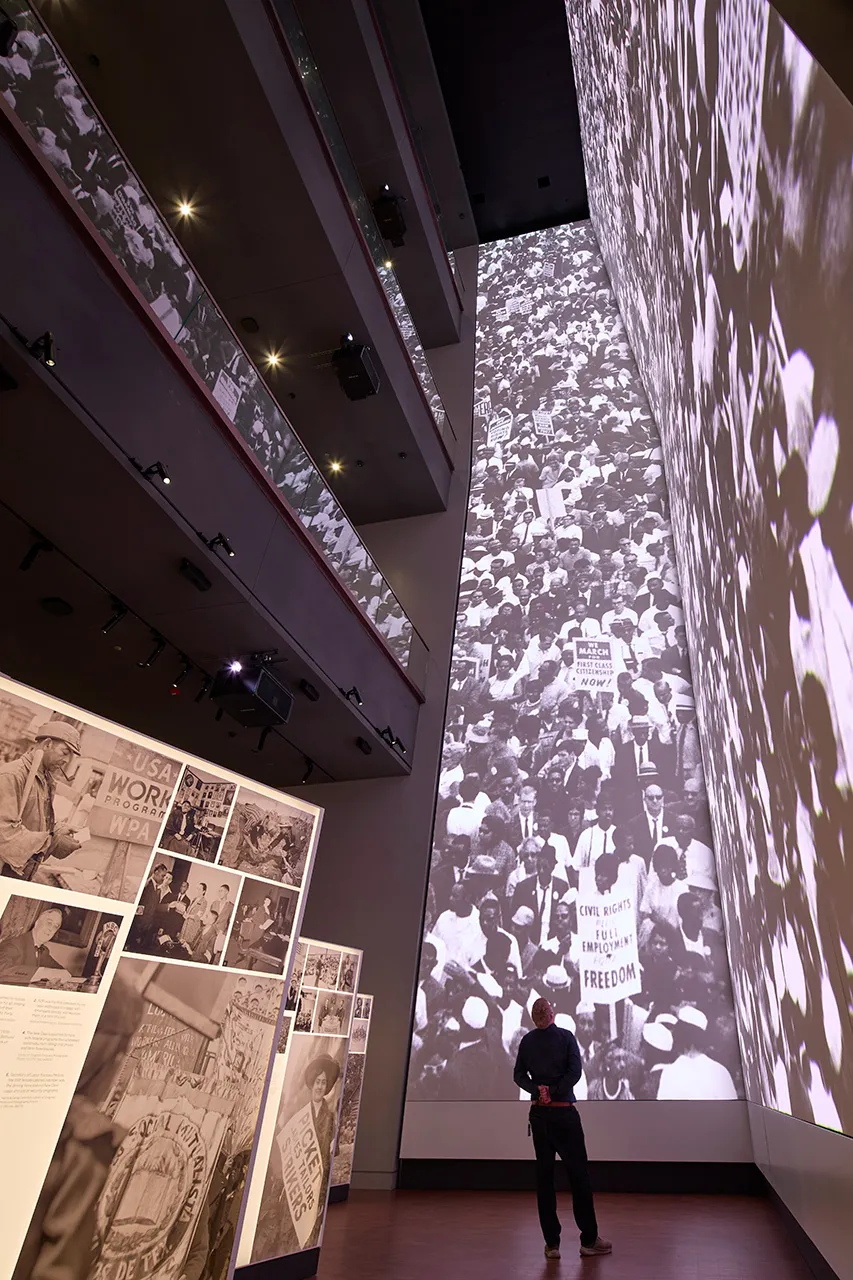
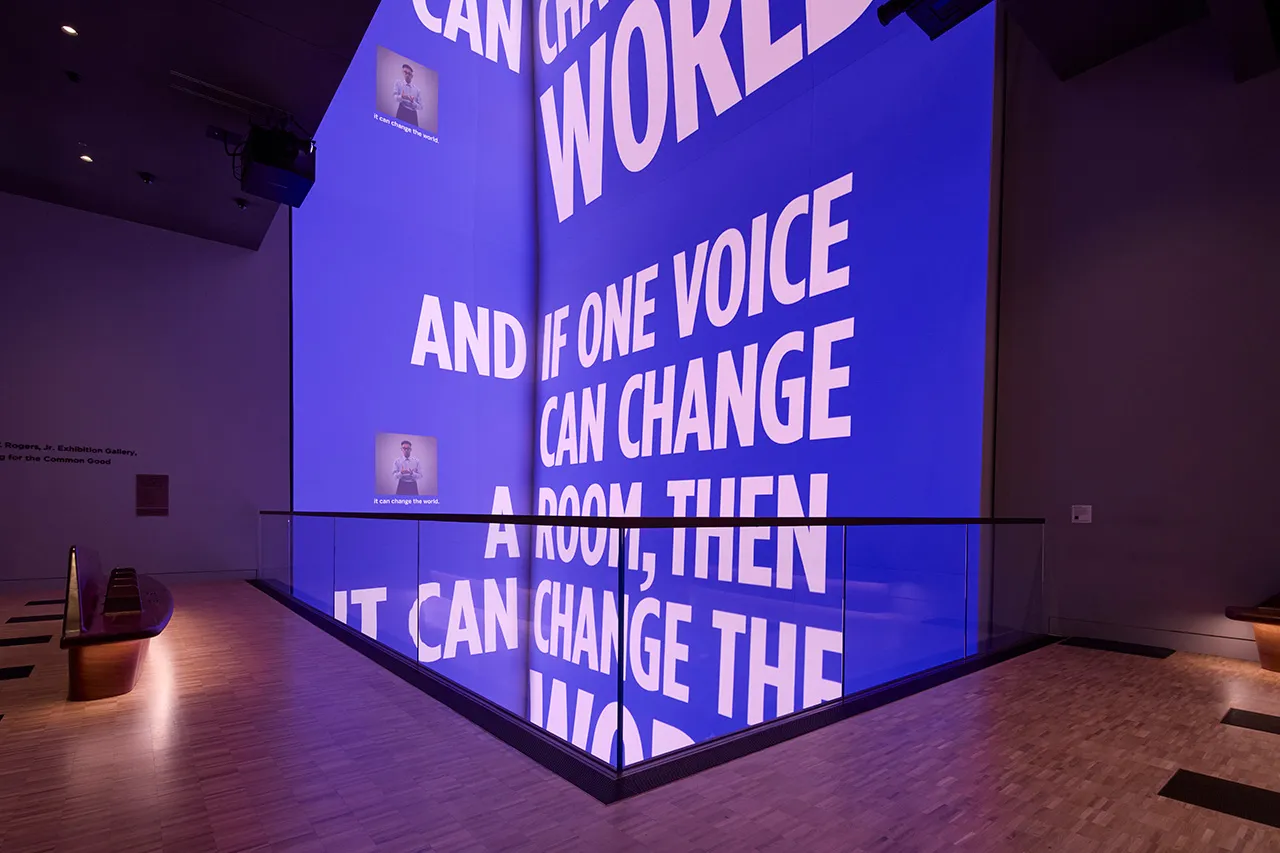
The Obama Foundation selected Scalable Display Technologies to calibrate the museum's most technically demanding installations — an 85-foot projection canvas spanning four gallery floors and an eight-projector circular projection ring — with automated recalibration that runs without a projection specialist onsite.
The Obama Presidential Center opened to the public on June 19, 2026 — Juneteenth — on a nearly 20-acre campus in Chicago's Jackson Park. The Center rises across eight floors, four of them given to public museum space exploring democracy, civic engagement, and social change through interactive exhibits, archival material, and large-scale immersive media.
Two of those installations are among the most technically demanding projection environments in any American museum. The Obama Foundation selected Scalable Display Technologies to handle automated camera-based calibration for both.
| Client | The Obama Foundation |
| Location | Chicago, Illinois |
| Opened | June 19, 2026 |
| Scalable software | Scalable Display Manager |
| Power of Words | 7 projectors, ~85 ft vertical span, 4 gallery floors |
| Projection ring | 8 projectors, 360-degree continuous surface |
| Media servers | AV Stumpfl PIXERA (35 systems museum-wide) |
| Show control | Medialon, under the ISAAC platform |
| Calibration output | MPCDI files, generated automatically |
Power of Words is the museum's centerpiece. It runs the full interior height of the building — roughly 85 feet — as a single projected canvas visible from balcony levels on every gallery floor. Seven projectors cover it: four in landscape orientation across the primary wall surface, three in portrait across an adjacent wall.
The second installation arranges eight projectors around a circular ring to form a continuous 360-degree surface, presenting custom digital artwork developed in collaboration with a French artist.
Large multi-projector systems need consistent alignment to hold a seamless image. Public buildings work against that constantly. Vibration, HVAC cycling, temperature swings, and steady visitor traffic all introduce small shifts over time. In the case of Power of Words, the projection surface is integrated directly into the building structure and spans four stories, so screen tension and geometry change subtly over the course of a year.
Traditionally, correcting that drift means bringing in specialized projection technicians to manually adjust geometry, warp, and edge blending — a process measured in days. For a museum operating daily without a projection specialist on staff, that workflow is not sustainable long-term.
"We needed a system that would allow us to automate alignment and maintain image quality without requiring constant manual intervention," said Paul Horst, senior manager of exhibition AV systems for the Obama Presidential Center.
Scalable's camera-based calibration treats multiple projectors as a single seamless display, automatically solving geometry and blending edges across surfaces of varying shape and scale. What traditionally required days of manual alignment by specialized technicians is instead completed through an automated recalibration workflow.
At the Obama Presidential Center, that workflow spans three vendors' systems.
"We've been working with Scalable on batch files to run calibration from the command line, automatically generate MPCDI files, copy those files into the media server and trigger the media server to load updated calibration data," Horst explained.
Medialon — the museum's scheduling and show control layer, operating under the ISAAC platform — initiates the sequence. PIXERA stops active timelines and deactivates outputs, hands control to Scalable for calibration, then reactivates the outputs and restarts the timelines once alignment is complete. The workflow also coordinates environmental conditions during recalibration, including projector warm-up periods and temporary lighting adjustments.
"The recalibration process inside Scalable's software has worked extremely well," said Horst. "It's very helpful to warm up the projectors, run recalibration and achieve a clean updated alignment without extensive manual work."
The result is a recalibration an operator can trigger without touching projection software, and without a technician on a ladder.
The atrium's architecture created a geometric problem that required new capability. Because of balcony placement and limited projector mounting positions, the system had to project across two intersecting wall planes meeting at nearly 90 degrees. Several projectors operate at extreme angles where image spillover between adjacent surfaces becomes difficult to manage.
Scalable worked directly with the Obama Foundation to develop a new software feature, Projector Groups, which performs independent warp-and-blend operations on separate projection surfaces while maintaining controlled edge transitions between content regions.
"That allowed independent warp and blend operations on each wall with a defined hard-edge seam between content regions," Horst explained.
Before committing to the full installation, the Obama Foundation built both a full-scale projection mock-up and a six-foot scale model replicating the final projector configuration, using compact projectors and smaller media servers. That let the project team and Scalable's engineers validate geometry, camera placement, media playback, and calibration behavior at bench scale.
"By the time we entered the building installation phase, we already felt confident the system would work," said Horst.
With alignment stable and recalibration automated, exhibit designers and media producers were able to spend deployment time refining content presentation rather than resolving projection issues.
Horst also pointed to the working relationship as a decisive factor. "One of the biggest factors, honestly, wasn't technical — it was customer service," he said. "They've been very active throughout the process, added entirely new software features to solve challenges unique to our project and responded quickly whenever issues came up."
The finished installation earns the compliment every calibration engineer actually wants. "The installation looks extremely clean," Horst said. "Honestly, one of the best outcomes is that nobody comments on the projection itself, which is exactly what you want. It simply looks the way it's supposed to look."
The same camera-based calibration workflows Scalable deploys in defense and aerospace simulation are used in museums, planetariums, theme parks, and large-scale immersive exhibits — anywhere multiple projectors must behave as one unified image and stay that way without daily specialist attention.
If you are planning a multi-projector installation and want to understand what automated recalibration would look like in your venue, get in touch.
Our team has deployed Scalable technology in environments like this on every continent. Let's talk about your project.