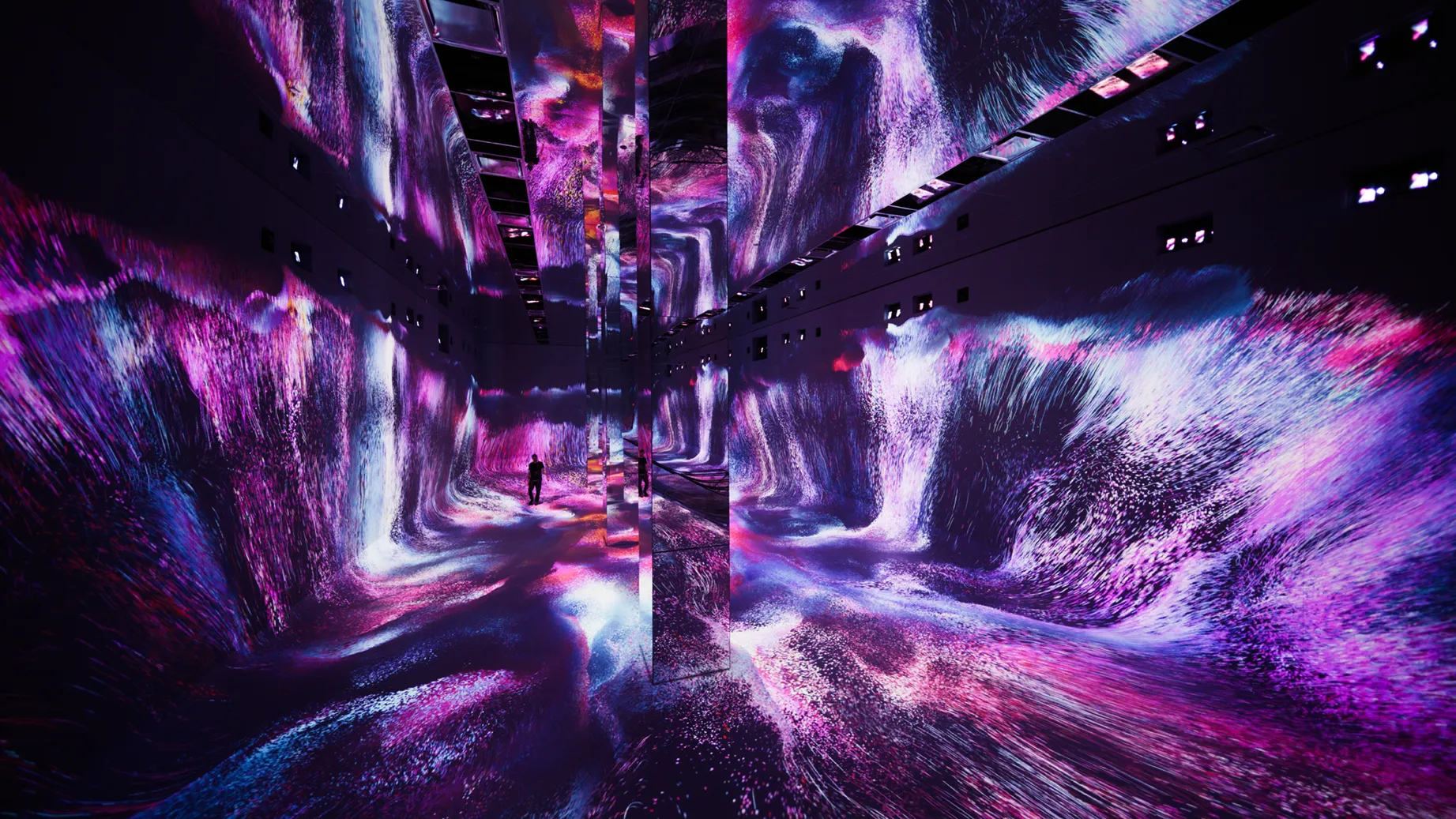
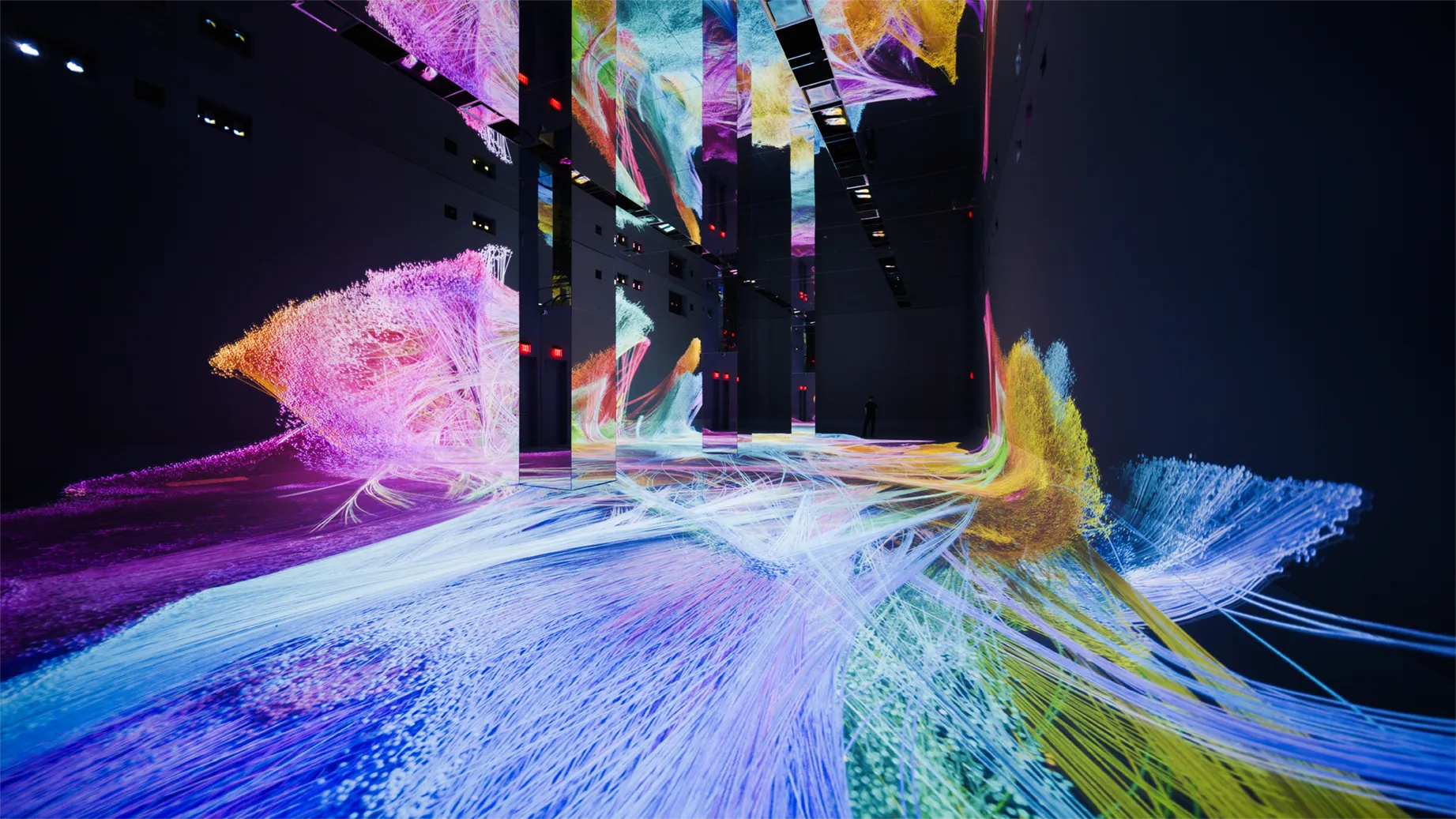
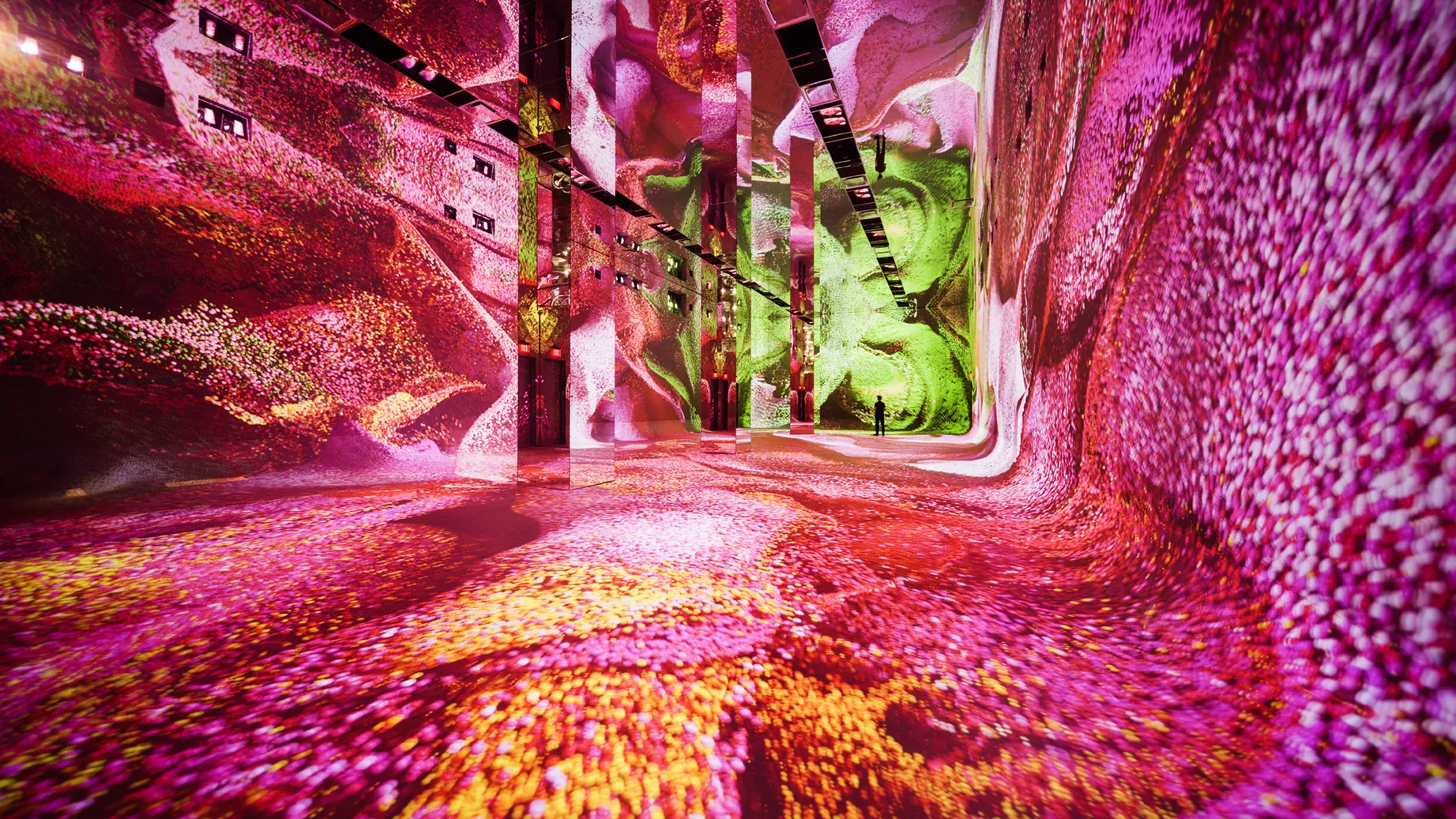
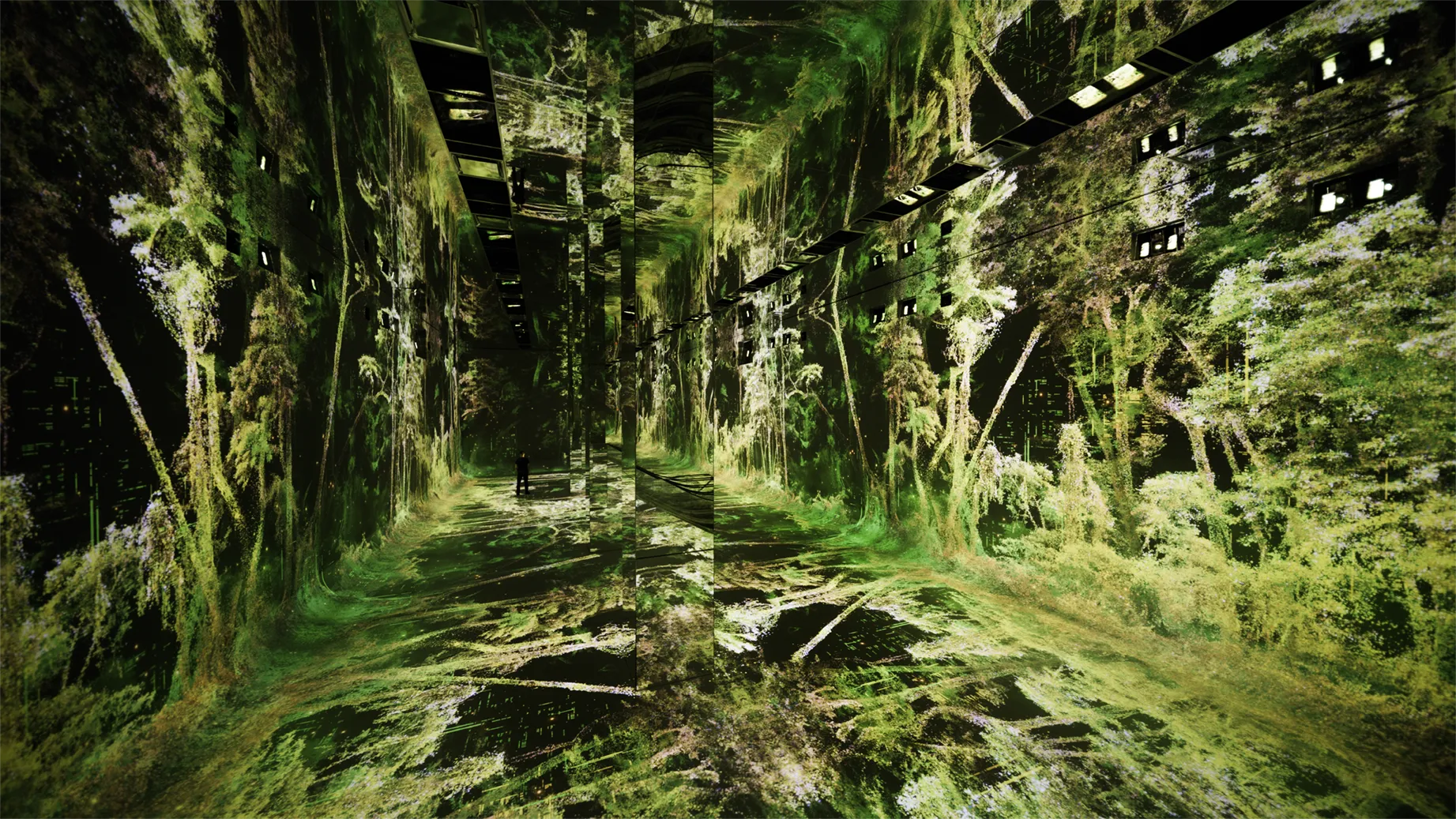
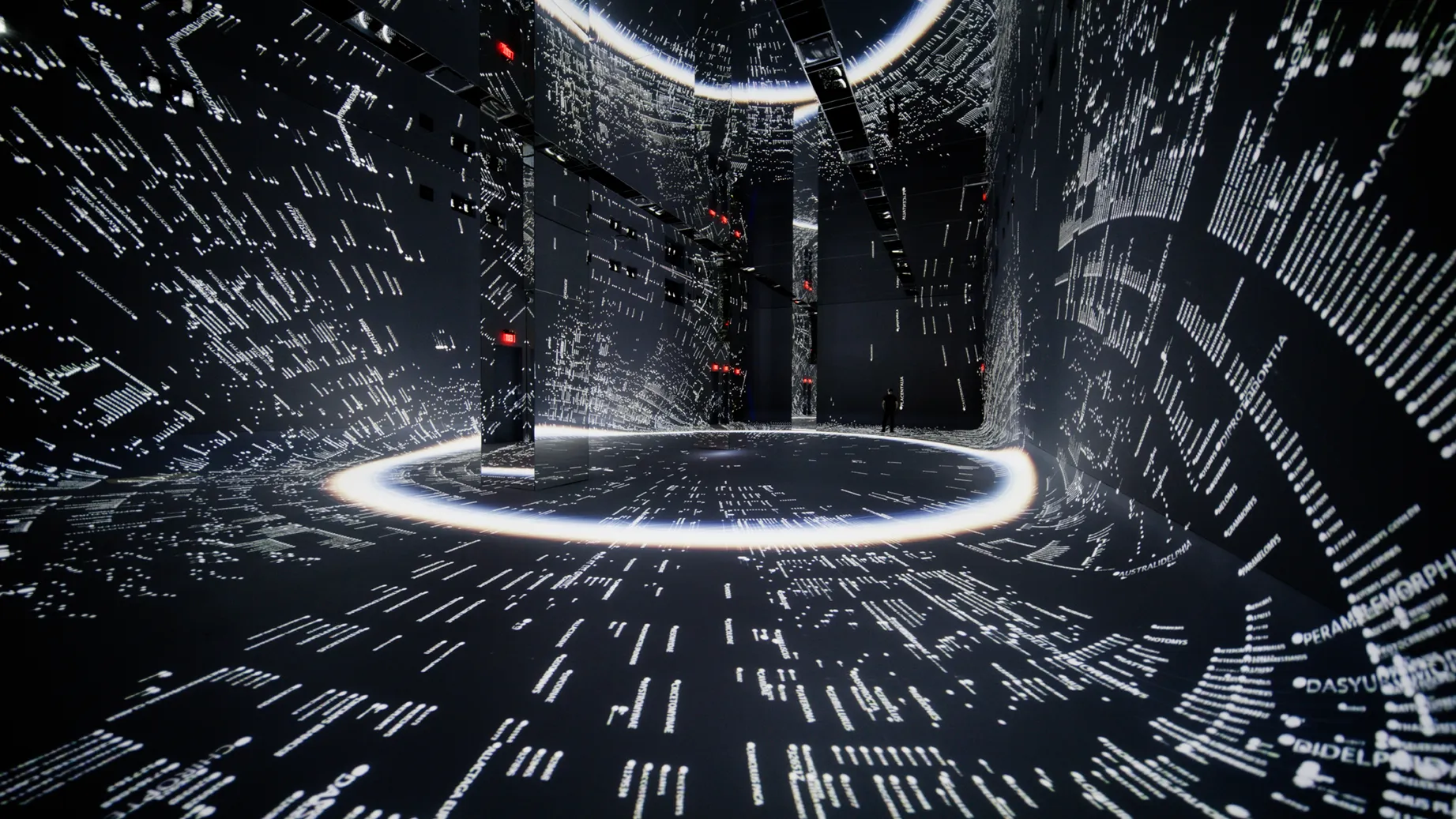
At Refik Anadol Studio's DATALAND, eighty-four double-stacked 4K projectors merge into one seamless architectural canvas across curved, mirrored gallery surfaces. Scalable's camera-based calibration delivers sub-pixel stack registration and one-click recalibration — keeping the Data Pavilion perfect every day, maintained entirely by museum staff.
84 X 4K PROJECTORS DOUBLE STACKED
9 CAMERAS
Refik Anadol Studio does not work at the edge of what display technology can do by accident. It is the point. DATALAND is the world's first museum of AI arts, opened in June 2026 inside Frank Gehry's The Grand LA, it was conceived as a building that responds: real-time generative imagery driven by live ecological data, visitor biometrics, and lidar tracking, across five galleries and a claimed 1.5 billion pixels.
The Data Pavilion is the centerpiece and the hardest surface in the building. Eighty-four 4K Epson projectors, each rated at 20,000 lumens, cover a fully custom architectural volume. The artistic requirement was absolute and simple to state: the canvas is the artwork's only interface with the visitor, so it has to be perfect. Not perfect at handover, perfect on a Tuesday in March, two years in, with no one from a projection vendor in the building.
That requirement is what turns a large projection system into a hard engineering problem. Every challenge below follows from it.
Refik Anadol Studio tested the native warp-and-blend tools built into projectors from multiple manufacturers, in their own studio, before the building was fitted out. All of them failed.
This is not a criticism of those tools. Projector-native warp and blend is designed for what it is designed for: regular arrays on flat or gently curved screens, where a technician can adjust a grid by eye and be finished. It has three structural limits that DATALAND ran straight into.
It has no model of the room. Each projector warps its own output in isolation. Nothing in the system knows the shape of the screen, or where the neighbouring projector's pixels land. Correctness is an emergent property of a human operator's judgement, projector by projector.
It is open-loop. Nothing measures the result. There is no feedback path from what is actually on the wall back into the correction being applied, so there is no definition of "aligned" other than the operator's eye, and no way to reproduce it. Maintenance nightmare.
It does not scale. Manual grid adjustment across 84 channels on non-developable geometry has more degrees of freedom than a human can converge on, and the effort has to be repeated in full every time anything moves.
Scalable was brought in as a specialist for the reason specialists exist: this is the only thing we do. Our approach is camera-based and closed-loop high accuracy systems. Nine permanently installed GigE machine-vision cameras observe the projected image. The software solves a single unified model of the screen surface and of every projector's optical relationship to it, then generates per-projector geometry, blend, and color maps from that model. Alignment is measured, not estimated, and because it is measured, it is repeatable on demand.
Every projector position in the Data Pavilion is double-stacked: two 4K projectors covering the same area of screen with the same image. This was a deliberate technical answer to two problems inherent to projection.
Brightness. Anadol's work depends on impact which requires luminance. Stacking projectors delivers twice the light per pixel of what a single unit is capable of, what the manufacturer did not sell and could not offer, Scalable achieved in the field.
Redundancy. In a projector or LED array, a device failure is a hole in the display. A visible and distracting contrast. With projection in a stacked array, it is a localized and managed dimming. The museum stays open. The exhibition stays intact. The experience is not broken.
The cost of stacking is registration. Two 4K images sharing one patch of screen must agree at the sub-pixel level. Miss by half a pixel and the stack reads as soft, unfocused, the resolution paid for twice is delivered once, blurred. Mechanical alignment cannot reliably reach that tolerance at 4K, and even where it can, it does not hold: thermal cycling and structural movement pull the two devices apart within days.
Scalable treats each projector in a stack as a fully independent channel within the global solve. Both are warped to the same measured target geometry, so registration is achieved computationally against a common reference rather than mechanically against each other, and colour and luminance are matched so that the pair reads as a single source. Critically, it is re-achieved from scratch every time the system is recalibrated. It is maintained by museum staff. Sub-pixel stack registration becomes a routine output of the software rather than a fragile condition established once at commissioning.
The Data Pavilion is not a screen. It is architecture: curved corners, pillars, a projected ceiling, mirrored surfaces integrated into the design, and cut-outs throughout the volume to accommodate motion-tracking and sensory hardware.
Mirrors are the specific adversary of camera-based calibration. Structured-light patterns projected onto the screen are reflected back into the cameras' field of view as ghost detections, arriving at plausible-looking coordinates that belong to no real surface. An automated solve that ingests them produces a confidently wrong answer. Stray light from high-output projectors also scatters onto surfaces never intended to receive image, degrading contrast in a gallery where black level is doing narrative work.
Three capabilities in the Scalable toolset addressed this:
Any capable team can align a projection system once, given enough time and a quiet building. The requirement at DATALAND was that the system be as good on its thousandth day as its first, and that it be maintained entirely by museum staff, without dependency on Scalable.
Alignment degrades. Thermal shift moves optics, day and night in California sees significant temperature swings which also causes thermal expansion and contraction of the building and structural elementys. Vibration and building movement move mounts, even slightly. Service events move projectors. Eartquakes are a real and frequent occurance in the region. In a stacked, mirrored, custom-geometry environment, that drift compounds faster and is visible sooner than in a conventional array.
The operational answer is one click. Cameras capture the current state of the projected image on demand; the software re-solves and re-applies geometry, blend, and colour across all eighty-four projectors, including stack registration. It runs as part of the museum's routine, executed by in-house technical staff, and returns the canvas to its measured, correct state
Delivering that at this scale drove product development on Scalables product line. Features, options, and workflow tooling built during the DATALAND integration are now part of the shipping product and available to every customer working in comparably difficult conditions.
DATALAND opened to the public on June 20, 2026 with the inaugural exhibition Machine Dreams: Rainforest, developed in collaboration with the Yawanawá community of the Amazon. The Data Pavilion's eighty-four projectors operate as one continuous architectural canvas. Seams are not visible. Curves and corners hold. The stacked pairs resolve as single, full-resolution sources at twice the manufacturer's rated brightness. Recalibration is a museum staff task, not a service call.
Anadol has described the founding question behind the museum as whether artworks might "feel us back." The projection layer is not the part of DATALAND that feels anything. It is the part that has to be invisible, permanently, so that everything above it can work.
That is the job we do: the final mile of an immersive project, where the difference between a system that was aligned once and a system that is aligned every day is the difference between a technical achievement and a visitor experience.
Artistic direction: Refik Anadol Studio. Architecture: Gensler. Prime engineering and AV owner's representative: Arup. Immersive design support: Constellation Immersive. Projection: Epson. LED: Absen. Displays: LG. Audio: L-Acoustics (L-ISA, 250 loudspeakers). Compute: NVIDIA, Google Cloud. Olfactory: L'Oréal Luxe. Projector alignment, blending, and colour calibration: Scalable Display Technologies.
Technical details and quotations drawn from official DATALAND and Refik Anadol Studio press materials (January 2024 – June 2026) and industry coverage in AV Magazine, invidis, AVNation, and CLAD, together with Scalable Display Technologies' own project record. © 2026 Refik Anadol Studio on behalf of DATALAND. Photos: Refik Anadol Studio.
Our team has deployed Scalable technology in environments like this on every continent. Let's talk about your project.